
How to Verify a Chinese Factory Before Your First Order (6-Step)
How to Verify a Chinese Factory Before Your First Order (6-Step)
To verify Chinese factory claims before your first order, run six checks in sequence: business licence and 18-character credit code on gsxt.gov.cn, an unscheduled live video tour, traceable third-party test reports, a sealed pre-production sample, first payment inside Trade Assurance, and a pre-shipment inspection at AQL 2.5. The full sequence costs roughly $500-$1,000 and takes two to three weeks (Doge Consulting due-diligence guide, 2026) - against orders worth tens of thousands.
How to Verify Chinese Factory Claims: The Six Steps in Order
Order matters. Each step is cheaper than the one after it, and each one can kill the deal before you spend money on the next. A registry check costs nothing and takes five minutes. An inspection costs a few hundred dollars. If you run them in reverse you end up paying for an inspection at a company that was never a factory in the first place. ChinaWithMe's 2026 supplier guide estimates that 12% of new Alibaba supplier listings are either outright scams or trading companies presenting as manufacturers, which is precisely the population the first two steps are designed to remove.
Step 1 - Registry
Business licence and 18-character Unified Social Credit Code checked against the government registry. Free, five minutes, no deposit at risk.
Step 2 - Live video tour
An unscheduled walk of the production floor, driven by your instructions, not their script. Free.
Step 3 - Test reports
Third-party lab reports that name your product, a real lab and a date inside twelve months. Free to request, chargeable if new tests are needed.
Step 4 - Pre-production sample
A paid sample built on the production tooling, then sealed and signed as the reference. Typically $50-$300 plus courier.
Step 5 - Escrow the first payment
Deposit placed inside Trade Assurance or an equivalent held-funds structure, never a personal account.
Step 6 - Pre-shipment inspection
AQL sampling against the sealed sample before the balance is released. Roughly $200-$500 per man-day.
The six steps answer six different questions, and none of them substitutes for another. Badges answer none of them - Gold Supplier is a paid membership rather than a production audit, which we unpack separately on the blog rather than repeating here.
Step 1: Pull the Business Licence and Check the Credit Code
Ask for a colour scan of the business licence and the 18-character Unified Social Credit Code as text, not as an image you have to retype. The code is the company's identifier across registration, tax and customs systems, and it is structured rather than random: positions 3-8 encode the administrative division where the company is registered, and position 18 is a checksum (QCC KYC USCC guide, 2026). If a supplier claims a Zhejiang factory and the code resolves to a different province, that is a question to ask before anything else.
Then search that code on gsxt.gov.cn, the National Enterprise Credit Information Publicity System run by the State Administration for Market Regulation. It is free and authoritative. ChinaCheck's 2026 guide puts the minimum version of this check at under five minutes per supplier and estimates it catches roughly 70% of bad-actor cases on its own. Six fields decide the outcome.
| Field on the record | What a pass looks like | What a fail looks like |
|---|---|---|
| Registered name | Matches the licence scan character for character | Approximate match, or an English trading name with no registered equivalent |
| Registration status | Active / in operation | Cancelled, revoked, or flagged to the abnormal operations list |
| Business scope | Includes production, processing or manufacturing wording | Wholesale, retail or import-export only - you are talking to a middleman |
| Legal representative | Matches the person signing your contract or proforma | A name nobody at the company has ever mentioned to you |
| Establishment date | Consistent with the track record they claim | Eighteen months old with a fifteen-year story attached |
| Registered address | Reconciles with the factory address given to you | A residential unit, or a different province entirely |
Two cautions. Registered capital is usually a subscribed figure rather than cash paid in, so treat it as a seriousness signal and nothing more (industry data, 2026). And a shared registered address is normal in Shenzhen, Guangzhou and Yiwu, where registered-agent addresses are routine - it is not a fraud signal on its own.
Step 2: Run a Live, Unscheduled Video Factory Tour
A recorded video proves nothing. A live call proves a great deal, because you control the camera by voice. Book it inside Chinese working hours, ideally without much notice, and drive the walk: ask them to turn left, to open a specific machine's guard, to walk to the raw material store, to point the camera at the ceiling and then at the floor. Mangors Sourcing's 2026 verification data notes that legitimate factories generally comply with a video tour request within 24-48 hours; the delay pattern itself is information.
What we watch for in Yiwu is simple: whether the person holding the phone is willing to turn left when we ask them to turn left. A real maker will, awkwardly and with the machines audible in the background. Booth staff from the Trade City almost always film from a showroom instead, because their stock is produced in Jinhua, Yongkang or Wenzhou - anywhere from forty minutes to two hours away by road - and they physically cannot show you a line. Neither answer ends the conversation, but you need to know which one you are getting before you write "factory direct" on your own website.
- Ask them to walk from the machines to the finished-goods store in one unbroken shot
- Ask to see other clients' branded cartons on the floor - real factories have them stacked everywhere
- Ask a technical question mid-walk: machine tonnage, cycle time, monthly capacity for your item
- Screenshot the walk and reverse image search the stills afterwards
- Note whether anyone on the call can answer without stepping away to phone someone else
Step 3: Demand Third-Party Test Reports You Can Trace
Test reports are the most commonly recycled document in China sourcing, usually because a supplier genuinely tested a similar product three years ago and sees no harm in sending that file. The report is only useful to you if four things are true: it names your exact product or model, it names a laboratory you can find and contact independently, it cites the standard your destination market requires, and it is dated inside the last twelve months. Ask for the report number and check it with the issuing lab rather than with the supplier.
The four-field report test
Product named, lab named and reachable, correct destination standard cited, dated within twelve months. Fail any one and treat the product as untested. If you are unsure which standard applies to your item, ask us through the inquiry form before you order.
Step 4: Buy a Pre-Production Sample and Seal It
Pay for the sample. Mangors Sourcing's 2026 figures put samples at $50-$300 plus $30-$80 in courier charges, and its guidance is worth repeating: a supplier who is too eager to give samples away free is frequently a trading company holding stock rather than a factory making it. What you want is not a shelf sample but a pre-production sample built on the tooling and materials that will run your order.
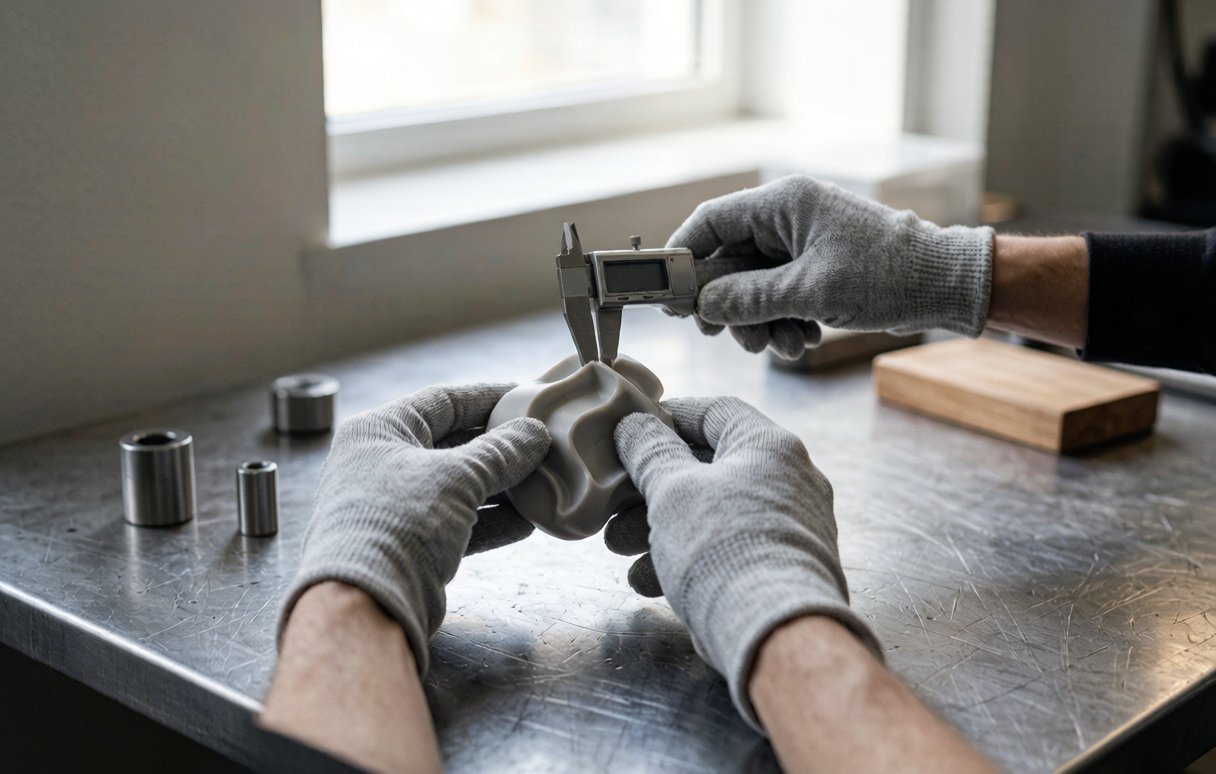
Then seal it. When we approve a sample in Yiwu we photograph it inside the carton alongside the packing list, attach a signed and dated tag, keep one unit in the office and courier a second to the client. Twice in the last year that sealed unit is the only reason a rework bill was paid by the factory rather than by the buyer - the sealed reference converted a subjective argument about shade and finish into a documented deviation. An unsealed sample is a memory, and memories lose disputes.
- Specify that the sample must be made with production tooling and production material, not hand-finished
- Order two or three identical units, not one - variance between them is the real signal
- Photograph the sample from six angles, with a scale reference in frame
- Sign and date a tag on the retained unit and have the supplier sign a copy
- Write into the purchase order that bulk not matching the sealed sample triggers rework at the supplier's cost
Step 5: Put the First Payment Inside Trade Assurance
For a first order, structure the payment so that the platform holds the funds. Alibaba.com's Trade Assurance is free to buyers and mediates disputes on quality and shipping deadlines as written into the order contract, but it carries one rule that overrides everything else in its terms: it only applies to orders placed and paid through the platform. Any payment redirected to a personal account, a wire outside the platform, or a newly opened offshore account voids it entirely (Alibaba.com Trade Assurance programme terms, 2026).
Two operational details decide whether the protection is real. First, everything you care about must be written into the order contract - specifications, tolerances, packaging, the sealed sample reference, and the inspection requirement. Verbal promises and chat messages that never made it into the contract are not covered. Second, the platform's published post-delivery inspection window is 15 days (Alibaba.com Seller Center guide, 2026), so a claim discovered in week four of unpacking is a claim you have already lost. Before the wire leaves, match the proforma invoice header and bank account name against the registry record from Step 1 - a mismatch there means you are paying a different legal entity than the one you verified.
Step 6: Book a Pre-Shipment Inspection Before the Balance
The inspection is what converts the previous five steps into leverage, because it happens while the supplier still wants 60-70% of the money. A pre-shipment inspection runs when production is complete and roughly 80% packed. The inspector pulls a random sample under ISO 2859-1 General Inspection Level II, checks against your sealed sample and specification, and reports with photographs inside 24-48 hours.
Know the arithmetic before you book. For a lot of 1,201-3,200 units the standard sample size is 125 pieces; at AQL 2.5 for major defects the lot accepts on 5 defects and rejects on 6 (ISO 2859-1, General Inspection Level II). The conventional consumer-goods setting is 0 critical / 2.5 major / 4.0 minor. On price, 2026 third-party inspection provider data puts the typical Asia man-day at $200-$500, with most general consumer-goods work quoted in the $250-$350 band, and QIMA's published Zone A rate at around $309 per man-day. Book it yourself, or through a party that answers to you - never let the supplier arrange their own examiner.
What a Pass and a Fail Actually Look Like
Most buyers can recite the steps but cannot say what closing each one looks like. A pass is not a feeling - it is a specific artefact you can file. If you cannot name the artefact, the step did not happen.
| Step | Pass artefact you should be holding | Fail signal |
|---|---|---|
| Registry check | Saved PDF of the registry record, active status, production in the business scope | No record for the code given, or a scope with no manufacturing wording |
| Video tour | Your own screen recording of a live walk you directed | A pre-recorded file, a showroom only, or repeated rescheduling |
| Test reports | Report naming your product, an independent lab, dated inside twelve months | A report for a similar product, an unnamed lab, or a date over two years old |
| Sample | Two sealed and signed reference units, one at each end | One unsealed sample, or a sample the supplier will not repeat identically |
| Payment | Escrowed deposit, invoice header matching the registry record | Request for a personal, third-party or newly opened offshore account |
| Inspection | AQL report with photographs, passed before balance release | Balance already paid, inspection scheduled by the supplier, or no report at all |
Red Flags That Should Stop the Conversation
Some findings are worth a question. These are not - each one is grounds to end the discussion and move to the next supplier, regardless of how good the price looks. Every one of them appears repeatedly in the 2026 verification literature and in our own files.
- Refusal to provide the business licence or the registered Chinese company name in text form
- Registry status showing cancelled, revoked, or a listing on the abnormal operations register
- A hit on the Supreme People's Court dishonest-debtor list for the company or its legal representative
- Any request to pay a personal account, a third-party company, or an account opened mid-negotiation
- Refusal of a live video call after two attempts, with a different excuse each time
- A quoted price 30% or more below every other quote you hold for the same specification
- Factory photographs that reverse image search to other listings or stock libraries
- Pressure to skip the sample stage because the tooling is 'already running'
Verification is the only part of a first order that costs hundreds instead of thousands. Skipping it is not a saving, it is a bet.
What Verification Costs and What It Saves
The whole sequence lands at roughly $500-$1,000 over two to three weeks for a typical consumer-goods first order (Doge Consulting, 2026): nothing for the registry check, nothing for the video tour, $80-$380 for samples and courier, and $250-$500 for the inspection. Against a $25,000 first order that is 2-4% of order value spent to remove the two failure modes that actually destroy first-time importers - paying an entity that does not exist, and accepting a container that does not match the sample.
RND Sourcing runs this sequence out of Yiwu for clients who cannot be in China for it, and the step that most often changes an outcome is not the dramatic one. It is Step 1. A five-minute registry check has ended more of our clients' negotiations than every inspection we have ever booked, because a business scope that says wholesale rather than production tells you in five minutes what a factory visit would have told you in five days. You can see how we structure the rest of the workflow on our about page, or at yourchinagent.com.
Verifying a Chinese Factory: Frequently Asked Questions
How long does it take to verify a Chinese factory?
Two to three weeks end to end for a first order, most of which is sample production and courier time. The registry check and video tour can both be completed in a single day.
Does a Gold Supplier badge mean the company is a factory?
No. Gold Supplier is a paid membership tier, not a production audit. Verified or Assessed status means a third party inspected some claims, but neither badge confirms the seller manufactures your specific product.
Can I verify a Chinese factory without speaking Chinese?
Yes for the registry check, using the 18-character credit code and browser translation. The video tour and the sample negotiation are much harder without Chinese, which is where a China-based partner earns their fee.
What AQL level should a first order use?
The standard consumer-goods setting is 0 critical, 2.5 major, 4.0 minor under ISO 2859-1. Tighten major defects to 1.5 for higher-value or safety-relevant products.
Is Trade Assurance enough on its own for a first order?
No. It protects the transaction if the order contract is specific and the payment stays on-platform, but it does not confirm the supplier is a manufacturer or that the goods match your sealed sample. Pair it with inspection.
Run the six steps in order and the expensive failures mostly disappear before you have spent more than a courier fee. If you would rather have the registry pull, the live walk, the sealed sample and the AQL inspection handled on the ground while you get on with selling, describe your product and target supplier in our inquiry form and we will tell you what we find before any deposit moves.


